NEMTIFY
NEMTIFY
Client
Client
NEMTIFY
NEMTIFY
Role
Role
Lead Product Designer
Lead Product Designer
Year
Year
2025
2025
Simplifying healthcare transportation by transforming fragmented dispatch operations into a connected, intelligent workflow.
Simplifying healthcare transportation by transforming fragmented dispatch operations into a connected, intelligent workflow.
Simplifying healthcare transportation by transforming fragmented dispatch operations into a connected, intelligent workflow.
Team
Team
Product Owner (Founder) • 4 Software Engineers • QA Engineer • Junior Designer • Lead Product Designer (Me)
Product Owner (Founder) • 4 Software Engineers • QA Engineer • Junior Designer • Lead Product Designer (Me)
Responsibilities
Responsibilities
Product Discovery • UX Research • Product Strategy • Product Design • Interaction Design • Design System • Usability Testing • Interactive Prototyping • Design - Dev Collaboration • Iterative Design
Product Discovery • UX Research • Product Strategy • Product Design • Interaction Design • Design System • Usability Testing • Interactive Prototyping • Design - Dev Collaboration • Iterative Design
Impact
Impact
• 25–35% faster trip scheduling • 20–25% reduction in dispatcher workload • 15–20% improvement in on-time dispatch performance • ~30% faster design-to-development iterations through a scalable design system and AI assisted workflows
• 25–35% faster trip scheduling • 20–25% reduction in dispatcher workload • 15–20% improvement in on-time dispatch performance • ~30% faster design-to-development iterations through a scalable design system and AI assisted workflows
Overview
Overview
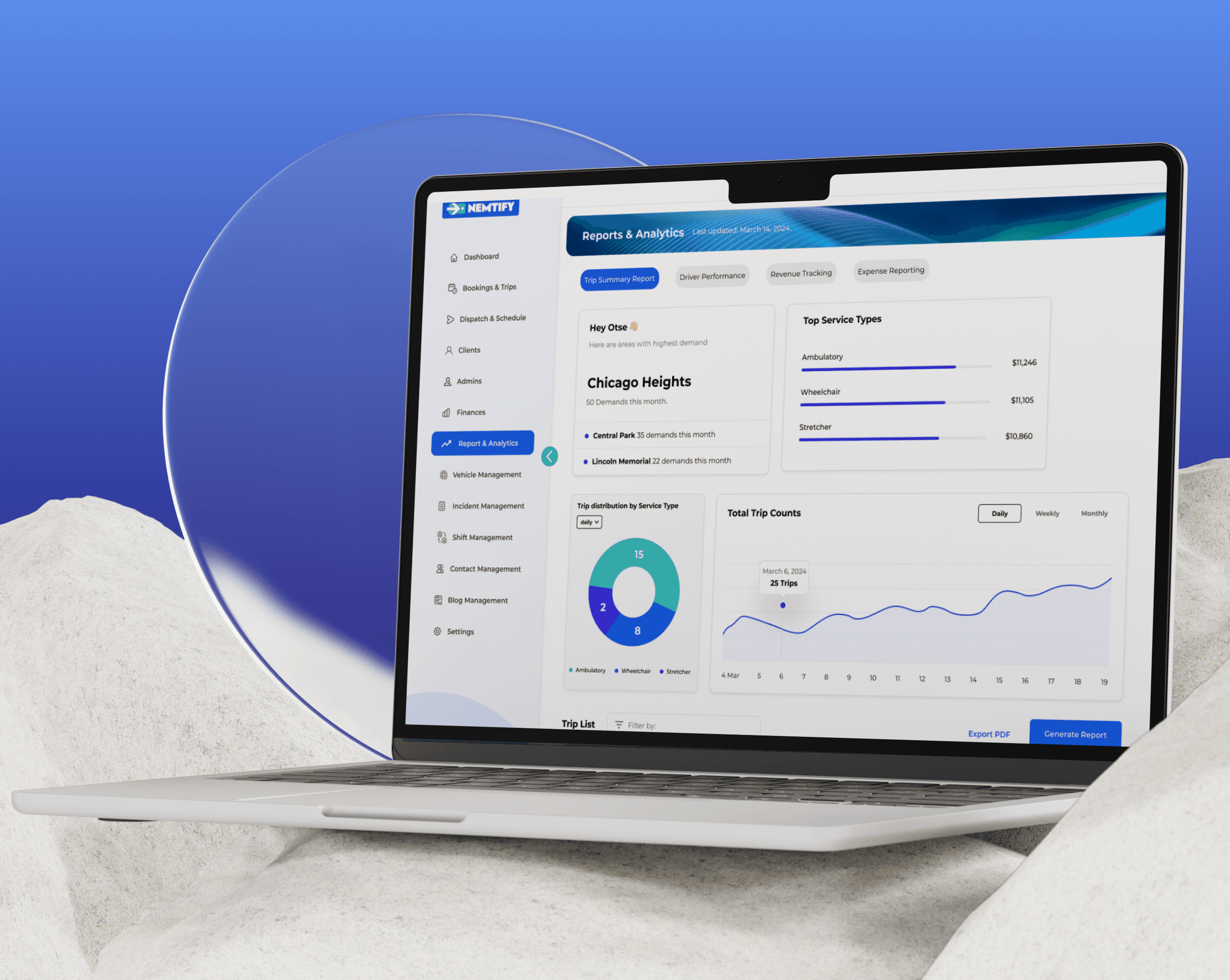
Overview - Nemtify is a comprehensive Non-Emergency Medical Transportation (NEMT) cloud SaaS platform designed to streamline and optimize the operations of NEMT providers. By integrating advanced scheduling, routing, invoicing and billing, fleet management, and driver communication capabilities into a single, user-friendly system, Nemtify enables providers to efficiently manage their day-to-day operations, reduce operational costs, and improve service delivery for their clients. My Role - As the Lead Product Designer, I owned the product design process end-to-end, partnering with the founder, engineers, and other stakeholders to shape the product from discovery through launch. Working within a distributed product team of 4 developers, 1 QA engineer, and a junior designer (whom I provided mentorship to all through the project), I helped define the MVP, align product decisions with user needs and business goals, and translate complex operational workflows into intuitive, scalable experiences. My responsibilities spanned product discovery, user interviews, stakeholder collaboration, competitive research, workflow mapping, information architecture design, low fidelity flows, prototyping, usability testing, and developer collaboration. I also established a scalable design system that reduced design-to-development transition time by approximately 25%, accelerated feature delivery, and improved consistency across the platform. Throughout the project, I worked closely with engineering to validate solutions, iterate based on user and stakeholder feedback, and ensure the final product balanced usability, operational efficiency, and technical feasibility.
Overview - Nemtify is a comprehensive Non-Emergency Medical Transportation (NEMT) cloud SaaS platform designed to streamline and optimize the operations of NEMT providers. By integrating advanced scheduling, routing, invoicing and billing, fleet management, and driver communication capabilities into a single, user-friendly system, Nemtify enables providers to efficiently manage their day-to-day operations, reduce operational costs, and improve service delivery for their clients. My Role - As the Lead Product Designer, I owned the product design process end-to-end, partnering with the founder, engineers, and other stakeholders to shape the product from discovery through launch. Working within a distributed product team of 4 developers, 1 QA engineer, and a junior designer (whom I provided mentorship to all through the project), I helped define the MVP, align product decisions with user needs and business goals, and translate complex operational workflows into intuitive, scalable experiences. My responsibilities spanned product discovery, user interviews, stakeholder collaboration, competitive research, workflow mapping, information architecture design, low fidelity flows, prototyping, usability testing, and developer collaboration. I also established a scalable design system that reduced design-to-development transition time by approximately 25%, accelerated feature delivery, and improved consistency across the platform. Throughout the project, I worked closely with engineering to validate solutions, iterate based on user and stakeholder feedback, and ensure the final product balanced usability, operational efficiency, and technical feasibility.
Overview - Nemtify is a comprehensive Non-Emergency Medical Transportation (NEMT) cloud SaaS platform designed to streamline and optimize the operations of NEMT providers. By integrating advanced scheduling, routing, invoicing and billing, fleet management, and driver communication capabilities into a single, user-friendly system, Nemtify enables providers to efficiently manage their day-to-day operations, reduce operational costs, and improve service delivery for their clients. My Role - As the Lead Product Designer, I owned the product design process end-to-end, partnering with the founder, engineers, and other stakeholders to shape the product from discovery through launch. Working within a distributed product team of 4 developers, 1 QA engineer, and a junior designer (whom I provided mentorship to all through the project), I helped define the MVP, align product decisions with user needs and business goals, and translate complex operational workflows into intuitive, scalable experiences. My responsibilities spanned product discovery, user interviews, stakeholder collaboration, competitive research, workflow mapping, information architecture design, low fidelity flows, prototyping, usability testing, and developer collaboration. I also established a scalable design system that reduced design-to-development transition time by approximately 25%, accelerated feature delivery, and improved consistency across the platform. Throughout the project, I worked closely with engineering to validate solutions, iterate based on user and stakeholder feedback, and ensure the final product balanced usability, operational efficiency, and technical feasibility.
Client
Client
NEMTIFY
NEMTIFY
Industry
Industry
Medical
Medical
Service
Service
UX Research & Design
UX Research & Design
Product Documentation
Product Documentation
Product Discovery
Product Discovery
Product Design
Product Design
B2B SaaS for Medical Transportation Service Operators
B2B SaaS for Medical Transportation Service Operators
Duration
Duration
8 Weeks
8 Weeks


The Challenge
The Challenge
Problem Statement - NEMT providers face numerous challenges that hinder efficient service delivery and increase operational costs. Common pain points include: - Inefficient scheduling and routing: Manual scheduling and static routing often result in delays, missed appointments, and wasted resources. - Poor fleet visibility: Difficulty in tracking vehicle locations, statuses, and driver availability leads to operational inefficiencies. - Fragmented invoicing and billing processes: Managing invoicing and billing manually or through disconnected systems increases errors and administrative burden. - Communication gaps: Lack of real-time communication between dispatchers and drivers results in poor coordination and delays. Nemtify was designed to address these challenges by providing an all-in-one, cloud-based platform that automates and optimizes critical NEMT operations. Goals - The primary goals for Nemtify were: 1. Streamline scheduling and routing by leveraging algorithms to automate route optimization. 2. Improve fleet management by providing real-time visibility of vehicles and drivers. 3. Automate invoicing and billing to reduce administrative workload and minimize errors. 4. Enhance driver communication through an integrated mobile app for drivers. 5. Provide a user-friendly experience for both tech-savvy and non-tech-savvy users.
Problem Statement - NEMT providers face numerous challenges that hinder efficient service delivery and increase operational costs. Common pain points include: - Inefficient scheduling and routing: Manual scheduling and static routing often result in delays, missed appointments, and wasted resources. - Poor fleet visibility: Difficulty in tracking vehicle locations, statuses, and driver availability leads to operational inefficiencies. - Fragmented invoicing and billing processes: Managing invoicing and billing manually or through disconnected systems increases errors and administrative burden. - Communication gaps: Lack of real-time communication between dispatchers and drivers results in poor coordination and delays. Nemtify was designed to address these challenges by providing an all-in-one, cloud-based platform that automates and optimizes critical NEMT operations. Goals - The primary goals for Nemtify were: 1. Streamline scheduling and routing by leveraging algorithms to automate route optimization. 2. Improve fleet management by providing real-time visibility of vehicles and drivers. 3. Automate invoicing and billing to reduce administrative workload and minimize errors. 4. Enhance driver communication through an integrated mobile app for drivers. 5. Provide a user-friendly experience for both tech-savvy and non-tech-savvy users.
Problem Statement - NEMT providers face numerous challenges that hinder efficient service delivery and increase operational costs. Common pain points include: - Inefficient scheduling and routing: Manual scheduling and static routing often result in delays, missed appointments, and wasted resources. - Poor fleet visibility: Difficulty in tracking vehicle locations, statuses, and driver availability leads to operational inefficiencies. - Fragmented invoicing and billing processes: Managing invoicing and billing manually or through disconnected systems increases errors and administrative burden. - Communication gaps: Lack of real-time communication between dispatchers and drivers results in poor coordination and delays. Nemtify was designed to address these challenges by providing an all-in-one, cloud-based platform that automates and optimizes critical NEMT operations. Goals - The primary goals for Nemtify were: 1. Streamline scheduling and routing by leveraging algorithms to automate route optimization. 2. Improve fleet management by providing real-time visibility of vehicles and drivers. 3. Automate invoicing and billing to reduce administrative workload and minimize errors. 4. Enhance driver communication through an integrated mobile app for drivers. 5. Provide a user-friendly experience for both tech-savvy and non-tech-savvy users.
Product Discovery & Design Strategy
Product Discovery & Design Strategy
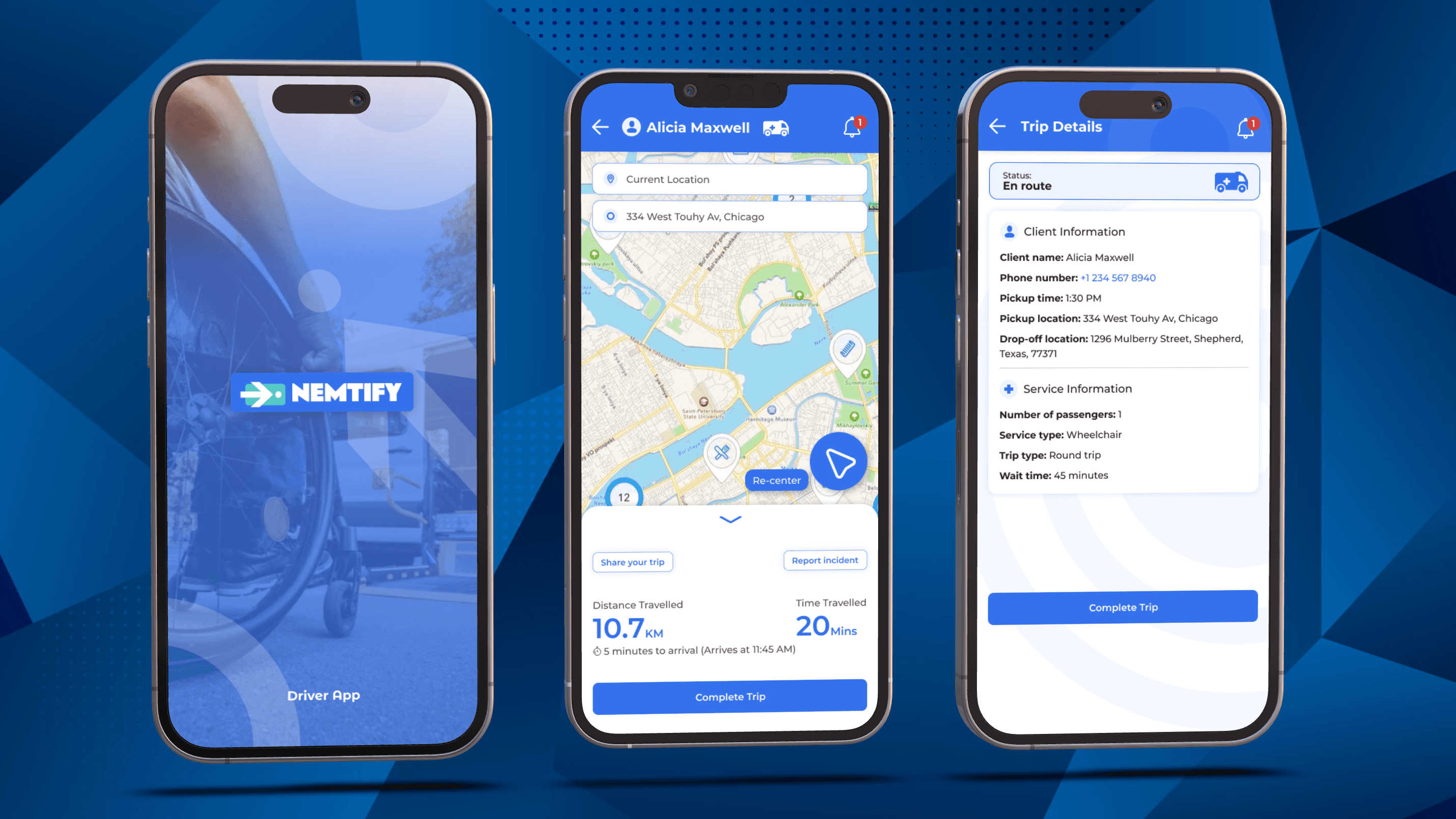
Understanding the Operational Landscape - Before exploring solutions, I partnered closely with the product owner (founder) to understand how NEMT providers managed scheduling, dispatch, routing, billing, and driver operations. My objective wasn't simply to design an interface—it was to identify the operational bottlenecks that had the greatest impact on efficiency and service delivery. Working with the founder, I conducted discovery interviews with operations managers, dispatchers, and drivers, complemented by competitive analysis of existing NEMT software like RouteGenie and Hi Bambi, identifying key worklows to understand how trips were coordinated from booking through completion, and also identifying key user painpoints, challenges and opportunities for improvement. Key Insights: - Manual scheduling and dispatch created significant delays, particularly during peak operating hours. - Providers relied on fragmented systems for fleet management, billing, communication, and compliance, resulting in duplicated work and limited operational visibility. - Dispatchers needed faster access to critical information, while drivers required simple, mobile-first workflows that minimized distractions on the road. - Given the varying levels of technical proficiency among users, simplicity and ease of use were essential for product adoption. These insights became the foundation for every product and design decision that followed. Defining the MVP - I worked closely with the founder and engineering team to define the product roadmap - translating our research findings into a focused MVP that addressed the highest-value operational challenges while remaining achievable within our delivery timeline. We prioritized features that would have the greatest day-to-day impact on transportation providers, including: - Intelligent scheduling and dispatch - Real-time fleet tracking - Driver mobile workflows - Automated billing and invoicing More advanced functionality was intentionally deferred to future releases, allowing us to validate the core workflows with users before expanding the platform. Design Exploration & Validation - The first major challenge was creating a comprehensive, unified platform that could support the day-to-day operations of multiple user types—Administrators, Fleet Managers, and Dispatchers—while also providing a robust mobile experience for Drivers and trip management. Defining User Workflows - Building on the MVP definitions and product roadmap established earlier, I focused on mapping the key workflows and user journeys for each user type and identifying the features they would need across the core MVP. The web-based portal was prioritized during the initial design and development sprints, with the Driver mobile app designed and developed in subsequent MVP sprints. Within the web portal, Administrators required broad access and control across the prioritized modules, while specialized roles such as Dispatchers and Fleet Managers needed focused access to the workflows relevant to their responsibilities—primarily Dispatch & Scheduling, Fleet Management, and Shift Management. Exploring the Information Architecture - Using insights from workflow mapping, user research, and competitor analysis, I explored different approaches to the platform's information architecture and overall layout. A key design goal was to avoid unnecessary visual complexity—an area where I found many competing products fell short—while ensuring that critical information and actions remained visible, accessible, and easy to navigate. I created low-fidelity flows in Figma for the core MVP modules: - User Management - Trip Management - Dispatch & Scheduling - Billing & Invoicing - Fleet Management These early flows helped establish the structure and navigation of each module while allowing us to identify potential usability issues before investing in detailed visual design. Validating Early Concepts - I facilitated review sessions and usability tests to validate the low-fidelity layouts and workflows with the founder, product team and key stakeholders, including NEMTIFY administrators, dispatchers, fleet managers, and other staff who would use the platform. These sessions helped validate whether the proposed designs adequately captured their operational workflows while surfacing areas of friction, complexity, and missing requirements early in the process. I iterated on the flows based on this feedback before progressing to high-fidelity design. Prototyping & Iteration - Once the core workflows were validated, I developed high-fidelity interactive prototypes in Figma that simulated key operational experiences across the platform. These included: - Trip scheduling and management - Dispatch management - Fleet monitoring - Billing and invoicing - Driver and trip management I created interactive prototypes separately for each MVP module, capturing the relevant workflows and interactions for each user type. These prototypes were then re-validated with users and stakeholders before implementation. Building for Design-to-Development - To support consistency across the product, I created a unified style guide and Figma design library, including reusable components and design variables. The variables were also translated into a JSON file to support easier implementation and handoff to engineering. Throughout development, I used Figma Dev Mode to collaborate closely with engineers, clarify design intent, and support accurate design-to-development implementation across multiple iterations. This iterative approach allowed the team to align on product direction early, validate workflows before development, and reduce unnecessary rework during implementation. Iterating with Users - Throughout the project, usability testing remained an integral part of the design process. I conducted multiple rounds of testing with dispatchers, drivers, and operational stakeholders to evaluate usability, validate assumptions, and uncover opportunities for refinement. Each iteration informed improvements to navigation, information hierarchy, workflow efficiency, and interaction patterns, ensuring the final experience balanced operational complexity with ease of use while meeting both user needs and business objectives. Design Impact - The design decisions were focused on making a complex operational platform feel clear, predictable, and easy to use across different user roles. Key UX improvements included: 1. Clarity of Information — Established clear visual hierarchy, grouping, and content structure to help users quickly understand and act on critical operational information. 2. Ease of Navigation — Created intuitive navigation structures and predictable interaction patterns, making it easier for users to move between modules and complete frequent tasks. 3. Progressive Disclosure — Reduced cognitive load by presenting essential information and actions first, while revealing secondary details and advanced options only when needed. 4. Smart Form Validation — Implemented contextual validation and clear error states within forms, helping users identify and correct issues immediately rather than discovering errors after submission. 5. Immediate Feedback & Micro-interactions — Used purposeful feedback states, loading indicators, confirmations, and subtle micro-interactions to make interactive elements feel responsive and keep users informed throughout their workflows.
Understanding the Operational Landscape - Before exploring solutions, I partnered closely with the product owner (founder) to understand how NEMT providers managed scheduling, dispatch, routing, billing, and driver operations. My objective wasn't simply to design an interface—it was to identify the operational bottlenecks that had the greatest impact on efficiency and service delivery. Working with the founder, I conducted discovery interviews with operations managers, dispatchers, and drivers, complemented by competitive analysis of existing NEMT software like RouteGenie and Hi Bambi, identifying key worklows to understand how trips were coordinated from booking through completion, and also identifying key user painpoints, challenges and opportunities for improvement. Key Insights: - Manual scheduling and dispatch created significant delays, particularly during peak operating hours. - Providers relied on fragmented systems for fleet management, billing, communication, and compliance, resulting in duplicated work and limited operational visibility. - Dispatchers needed faster access to critical information, while drivers required simple, mobile-first workflows that minimized distractions on the road. - Given the varying levels of technical proficiency among users, simplicity and ease of use were essential for product adoption. These insights became the foundation for every product and design decision that followed. Defining the MVP - I worked closely with the founder and engineering team to define the product roadmap - translating our research findings into a focused MVP that addressed the highest-value operational challenges while remaining achievable within our delivery timeline. We prioritized features that would have the greatest day-to-day impact on transportation providers, including: - Intelligent scheduling and dispatch - Real-time fleet tracking - Driver mobile workflows - Automated billing and invoicing More advanced functionality was intentionally deferred to future releases, allowing us to validate the core workflows with users before expanding the platform. Design Exploration & Validation - The first major challenge was creating a comprehensive, unified platform that could support the day-to-day operations of multiple user types—Administrators, Fleet Managers, and Dispatchers—while also providing a robust mobile experience for Drivers and trip management. Defining User Workflows - Building on the MVP definitions and product roadmap established earlier, I focused on mapping the key workflows and user journeys for each user type and identifying the features they would need across the core MVP. The web-based portal was prioritized during the initial design and development sprints, with the Driver mobile app designed and developed in subsequent MVP sprints. Within the web portal, Administrators required broad access and control across the prioritized modules, while specialized roles such as Dispatchers and Fleet Managers needed focused access to the workflows relevant to their responsibilities—primarily Dispatch & Scheduling, Fleet Management, and Shift Management. Exploring the Information Architecture - Using insights from workflow mapping, user research, and competitor analysis, I explored different approaches to the platform's information architecture and overall layout. A key design goal was to avoid unnecessary visual complexity—an area where I found many competing products fell short—while ensuring that critical information and actions remained visible, accessible, and easy to navigate. I created low-fidelity flows in Figma for the core MVP modules: - User Management - Trip Management - Dispatch & Scheduling - Billing & Invoicing - Fleet Management These early flows helped establish the structure and navigation of each module while allowing us to identify potential usability issues before investing in detailed visual design. Validating Early Concepts - I facilitated review sessions and usability tests to validate the low-fidelity layouts and workflows with the founder, product team and key stakeholders, including NEMTIFY administrators, dispatchers, fleet managers, and other staff who would use the platform. These sessions helped validate whether the proposed designs adequately captured their operational workflows while surfacing areas of friction, complexity, and missing requirements early in the process. I iterated on the flows based on this feedback before progressing to high-fidelity design. Prototyping & Iteration - Once the core workflows were validated, I developed high-fidelity interactive prototypes in Figma that simulated key operational experiences across the platform. These included: - Trip scheduling and management - Dispatch management - Fleet monitoring - Billing and invoicing - Driver and trip management I created interactive prototypes separately for each MVP module, capturing the relevant workflows and interactions for each user type. These prototypes were then re-validated with users and stakeholders before implementation. Building for Design-to-Development - To support consistency across the product, I created a unified style guide and Figma design library, including reusable components and design variables. The variables were also translated into a JSON file to support easier implementation and handoff to engineering. Throughout development, I used Figma Dev Mode to collaborate closely with engineers, clarify design intent, and support accurate design-to-development implementation across multiple iterations. This iterative approach allowed the team to align on product direction early, validate workflows before development, and reduce unnecessary rework during implementation. Iterating with Users - Throughout the project, usability testing remained an integral part of the design process. I conducted multiple rounds of testing with dispatchers, drivers, and operational stakeholders to evaluate usability, validate assumptions, and uncover opportunities for refinement. Each iteration informed improvements to navigation, information hierarchy, workflow efficiency, and interaction patterns, ensuring the final experience balanced operational complexity with ease of use while meeting both user needs and business objectives. Design Impact - The design decisions were focused on making a complex operational platform feel clear, predictable, and easy to use across different user roles. Key UX improvements included: 1. Clarity of Information — Established clear visual hierarchy, grouping, and content structure to help users quickly understand and act on critical operational information. 2. Ease of Navigation — Created intuitive navigation structures and predictable interaction patterns, making it easier for users to move between modules and complete frequent tasks. 3. Progressive Disclosure — Reduced cognitive load by presenting essential information and actions first, while revealing secondary details and advanced options only when needed. 4. Smart Form Validation — Implemented contextual validation and clear error states within forms, helping users identify and correct issues immediately rather than discovering errors after submission. 5. Immediate Feedback & Micro-interactions — Used purposeful feedback states, loading indicators, confirmations, and subtle micro-interactions to make interactive elements feel responsive and keep users informed throughout their workflows.
Understanding the Operational Landscape - Before exploring solutions, I partnered closely with the product owner (founder) to understand how NEMT providers managed scheduling, dispatch, routing, billing, and driver operations. My objective wasn't simply to design an interface—it was to identify the operational bottlenecks that had the greatest impact on efficiency and service delivery. Working with the founder, I conducted discovery interviews with operations managers, dispatchers, and drivers, complemented by competitive analysis of existing NEMT software like RouteGenie and Hi Bambi, identifying key worklows to understand how trips were coordinated from booking through completion, and also identifying key user painpoints, challenges and opportunities for improvement. Key Insights: - Manual scheduling and dispatch created significant delays, particularly during peak operating hours. - Providers relied on fragmented systems for fleet management, billing, communication, and compliance, resulting in duplicated work and limited operational visibility. - Dispatchers needed faster access to critical information, while drivers required simple, mobile-first workflows that minimized distractions on the road. - Given the varying levels of technical proficiency among users, simplicity and ease of use were essential for product adoption. These insights became the foundation for every product and design decision that followed. Defining the MVP - I worked closely with the founder and engineering team to define the product roadmap - translating our research findings into a focused MVP that addressed the highest-value operational challenges while remaining achievable within our delivery timeline. We prioritized features that would have the greatest day-to-day impact on transportation providers, including: - Intelligent scheduling and dispatch - Real-time fleet tracking - Driver mobile workflows - Automated billing and invoicing More advanced functionality was intentionally deferred to future releases, allowing us to validate the core workflows with users before expanding the platform. Design Exploration & Validation - The first major challenge was creating a comprehensive, unified platform that could support the day-to-day operations of multiple user types—Administrators, Fleet Managers, and Dispatchers—while also providing a robust mobile experience for Drivers and trip management. Defining User Workflows - Building on the MVP definitions and product roadmap established earlier, I focused on mapping the key workflows and user journeys for each user type and identifying the features they would need across the core MVP. The web-based portal was prioritized during the initial design and development sprints, with the Driver mobile app designed and developed in subsequent MVP sprints. Within the web portal, Administrators required broad access and control across the prioritized modules, while specialized roles such as Dispatchers and Fleet Managers needed focused access to the workflows relevant to their responsibilities—primarily Dispatch & Scheduling, Fleet Management, and Shift Management. Exploring the Information Architecture - Using insights from workflow mapping, user research, and competitor analysis, I explored different approaches to the platform's information architecture and overall layout. A key design goal was to avoid unnecessary visual complexity—an area where I found many competing products fell short—while ensuring that critical information and actions remained visible, accessible, and easy to navigate. I created low-fidelity flows in Figma for the core MVP modules: - User Management - Trip Management - Dispatch & Scheduling - Billing & Invoicing - Fleet Management These early flows helped establish the structure and navigation of each module while allowing us to identify potential usability issues before investing in detailed visual design. Validating Early Concepts - I facilitated review sessions and usability tests to validate the low-fidelity layouts and workflows with the founder, product team and key stakeholders, including NEMTIFY administrators, dispatchers, fleet managers, and other staff who would use the platform. These sessions helped validate whether the proposed designs adequately captured their operational workflows while surfacing areas of friction, complexity, and missing requirements early in the process. I iterated on the flows based on this feedback before progressing to high-fidelity design. Prototyping & Iteration - Once the core workflows were validated, I developed high-fidelity interactive prototypes in Figma that simulated key operational experiences across the platform. These included: - Trip scheduling and management - Dispatch management - Fleet monitoring - Billing and invoicing - Driver and trip management I created interactive prototypes separately for each MVP module, capturing the relevant workflows and interactions for each user type. These prototypes were then re-validated with users and stakeholders before implementation. Building for Design-to-Development - To support consistency across the product, I created a unified style guide and Figma design library, including reusable components and design variables. The variables were also translated into a JSON file to support easier implementation and handoff to engineering. Throughout development, I used Figma Dev Mode to collaborate closely with engineers, clarify design intent, and support accurate design-to-development implementation across multiple iterations. This iterative approach allowed the team to align on product direction early, validate workflows before development, and reduce unnecessary rework during implementation. Iterating with Users - Throughout the project, usability testing remained an integral part of the design process. I conducted multiple rounds of testing with dispatchers, drivers, and operational stakeholders to evaluate usability, validate assumptions, and uncover opportunities for refinement. Each iteration informed improvements to navigation, information hierarchy, workflow efficiency, and interaction patterns, ensuring the final experience balanced operational complexity with ease of use while meeting both user needs and business objectives. Design Impact - The design decisions were focused on making a complex operational platform feel clear, predictable, and easy to use across different user roles. Key UX improvements included: 1. Clarity of Information — Established clear visual hierarchy, grouping, and content structure to help users quickly understand and act on critical operational information. 2. Ease of Navigation — Created intuitive navigation structures and predictable interaction patterns, making it easier for users to move between modules and complete frequent tasks. 3. Progressive Disclosure — Reduced cognitive load by presenting essential information and actions first, while revealing secondary details and advanced options only when needed. 4. Smart Form Validation — Implemented contextual validation and clear error states within forms, helping users identify and correct issues immediately rather than discovering errors after submission. 5. Immediate Feedback & Micro-interactions — Used purposeful feedback states, loading indicators, confirmations, and subtle micro-interactions to make interactive elements feel responsive and keep users informed throughout their workflows.

The Solution
The Solution
Key Features - 1. Advanced Scheduling & Routing: Nemtify’s scheduling system automates route planning by considering factors such as vehicle capacity, driver availability, and client locations. Dispatchers can easily modify schedules, and the system recalculates optimal routes in real-time. 2. Fleet Management: The fleet management module provides real-time visibility of vehicles and drivers. Dispatchers can track vehicle locations, monitor driver availability, and receive status updates for ongoing trips. 3. Invoicing & Billing Automation: Nemtify automates the invoicing and billing process, reducing manual effort and minimizing errors. Providers can generate invoices based on completed trips, track payments, and manage billing histories. 4. Driver Communication: An integrated communication system enables real-time updates between dispatchers and drivers. Drivers receive job assignments, route details, and status update requests directly on the mobile app. Key improvements made: - Simplified the scheduling workflow by introducing bulk action capabilities. - Enhanced the mobile app interface for easier navigation by drivers. - Added color-coded status indicators for better fleet visibility
Key Features - 1. Advanced Scheduling & Routing: Nemtify’s scheduling system automates route planning by considering factors such as vehicle capacity, driver availability, and client locations. Dispatchers can easily modify schedules, and the system recalculates optimal routes in real-time. 2. Fleet Management: The fleet management module provides real-time visibility of vehicles and drivers. Dispatchers can track vehicle locations, monitor driver availability, and receive status updates for ongoing trips. 3. Invoicing & Billing Automation: Nemtify automates the invoicing and billing process, reducing manual effort and minimizing errors. Providers can generate invoices based on completed trips, track payments, and manage billing histories. 4. Driver Communication: An integrated communication system enables real-time updates between dispatchers and drivers. Drivers receive job assignments, route details, and status update requests directly on the mobile app. Key improvements made: - Simplified the scheduling workflow by introducing bulk action capabilities. - Enhanced the mobile app interface for easier navigation by drivers. - Added color-coded status indicators for better fleet visibility
Key Features - 1. Advanced Scheduling & Routing: Nemtify’s scheduling system automates route planning by considering factors such as vehicle capacity, driver availability, and client locations. Dispatchers can easily modify schedules, and the system recalculates optimal routes in real-time. 2. Fleet Management: The fleet management module provides real-time visibility of vehicles and drivers. Dispatchers can track vehicle locations, monitor driver availability, and receive status updates for ongoing trips. 3. Invoicing & Billing Automation: Nemtify automates the invoicing and billing process, reducing manual effort and minimizing errors. Providers can generate invoices based on completed trips, track payments, and manage billing histories. 4. Driver Communication: An integrated communication system enables real-time updates between dispatchers and drivers. Drivers receive job assignments, route details, and status update requests directly on the mobile app. Key improvements made: - Simplified the scheduling workflow by introducing bulk action capabilities. - Enhanced the mobile app interface for easier navigation by drivers. - Added color-coded status indicators for better fleet visibility

The Result
The Result
Outcome & Results - Following the launch of Nemtify, users reported significant improvements in operational efficiency: - 30% reduction in scheduling time due to automated route optimization. - 20% increase in on-time trips as a result of better fleet visibility and real-time updates. - 50% decrease in billing errors due to automated invoicing. - Positive user feedback on the platform’s ease of use and intuitive design. Takeaways - - Understanding user needs is critical: Early-stage research and ongoing feedback were essential in creating a product that met real-world needs. - Collaboration drives success: Close collaboration with stakeholders, developers, and users helped us build a product that delivered tangible value. - Iteration improves outcomes: Iterative design and testing helped us refine the product and address pain points effectively. This project provided invaluable experience in designing for the healthcare and transportation sectors, highlighting the importance of balancing complex functionality with a user-friendly interface.
Outcome & Results - Following the launch of Nemtify, users reported significant improvements in operational efficiency: - 30% reduction in scheduling time due to automated route optimization. - 20% increase in on-time trips as a result of better fleet visibility and real-time updates. - 50% decrease in billing errors due to automated invoicing. - Positive user feedback on the platform’s ease of use and intuitive design. Takeaways - - Understanding user needs is critical: Early-stage research and ongoing feedback were essential in creating a product that met real-world needs. - Collaboration drives success: Close collaboration with stakeholders, developers, and users helped us build a product that delivered tangible value. - Iteration improves outcomes: Iterative design and testing helped us refine the product and address pain points effectively. This project provided invaluable experience in designing for the healthcare and transportation sectors, highlighting the importance of balancing complex functionality with a user-friendly interface.
Outcome & Results - Following the launch of Nemtify, users reported significant improvements in operational efficiency: - 30% reduction in scheduling time due to automated route optimization. - 20% increase in on-time trips as a result of better fleet visibility and real-time updates. - 50% decrease in billing errors due to automated invoicing. - Positive user feedback on the platform’s ease of use and intuitive design. Takeaways - - Understanding user needs is critical: Early-stage research and ongoing feedback were essential in creating a product that met real-world needs. - Collaboration drives success: Close collaboration with stakeholders, developers, and users helped us build a product that delivered tangible value. - Iteration improves outcomes: Iterative design and testing helped us refine the product and address pain points effectively. This project provided invaluable experience in designing for the healthcare and transportation sectors, highlighting the importance of balancing complex functionality with a user-friendly interface.


PORTFOLIO
CHECK OUT SOME MORE
CHECK OUT SOME MORE
ProjectInfo
Product Design
B2B/B2C SaaS design
Product Thinking
AI optimized workflows
Interactive Prototyping
Eonace
UX/UI Design
Mobile App Design
Figma
Interactive Prototyping
Fintech App Design
HAVE A PROJECT
IN MIND ?